


Like most of us, I’ve been reading and thinking about AI (and LLM’s in particular) a lot lately.
And playing with them a good bit, too. Overall, I’m feeling lots of whiplash from “it’s amazing!!” to “it’s garbage”, back and forth. All of which has me thinking….to be sure you’re getting a good ROI on tech spending, it’s useful to think about the Two Halves of the Hype Cycle. Welcome to the first in a three-part series about how I think about this – which half do you want to spend your time on, and why?
We live through rapid, head-snapping hype cycles every year. Gartner famously published the Gartner Hype Cycle in a research note back in 1995, sketching a roller coaster of emotions as we become aware of new technologies and gradually figure out what role they should play in our lives (and businesses).
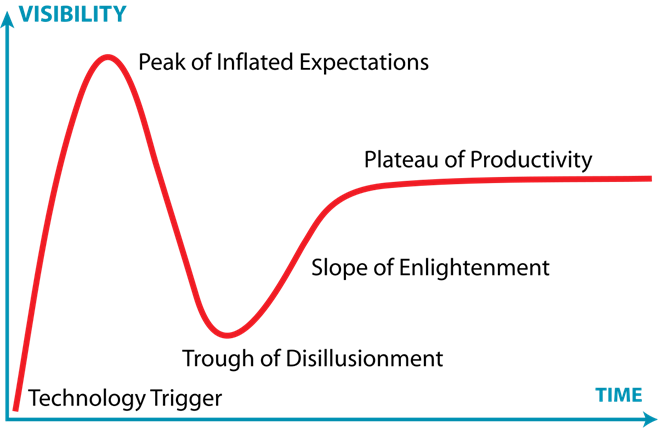
Source: Gartner
This cycle should feel familiar. We find out about something new and often get overly excited. Startups form, with eye-popping Series A valuations and wild claims in marketing materials. Then reality starts to break in – the momentum slows, then reverses. Companies merge, sometimes close. The press releases stop using “ground-breaking”, “revolutionary”, and “game-changing” so much. Founders leave, replaced with a more experienced manager as the new CEO. The Front Half of the Hype Cycle is a rollicking time, whether it’s good or not.
Then eventually, things start to calm down and level out. There are some real case studies with reasonable claims for value added. The Series B investment might be a down round, but people look at the valuation and say “yeah, that makes sense”. The Back Half of the Hype Cycle is slower, steadier, and more common-sense.
The Front Half
The Front Half of the Hype Cycle makes for very, very good storytelling. We see breathless headlines in news media and absurd claims on InstaTokLinkedIn. There’s an enormous amount of value to be found riding that first peak up to the mountain, but also a lot of frustration to be found riding the downward slope. Overpromises are made right alongside investments that look like genius. Reputations for “innovative” companies are largely built on the Front Half.

Kevin Hart, not having a good time.
I personally love riding roller coasters. Wooden or steel, big or little, I’m in. Adrenaline is a drug, and I’ve been known to partake. I particularly love the twisty parts on the bottom of an old wooden roller coaster, where you feel like you might run into the scaffolding at any time. And the look of joy-slash-terror on my 8-year-old’s face is just the best.
But as an entrepreneur, I can tell you that riding business roller coasters isn’t always as much fun! We need strategies to manage risks, open communication with leadership and investors about the chances of success, and a willingness to give up on a project if it’s just not working. I’ll dive deeper into this in Part Two of the series, but here are a few technologies that I believe are somewhere on the roller coaster today:
- Agentic AI
- Quantum computing
- World models (a new term to me just this month)
The Back Half
The Back Half of the Hype Cycle is frankly kind of boring in comparison to the front half. No one’s writing front-page articles for the newspaper or posting quick-cut YouTube videos. Work is being put out for competitive bids – the Procurement Department might even get involved! (groan….) But there is a lot of straightforward, risk-adjusted value being generated as everyone’s understanding of the value proposition gets better.
My bias is that most E&P companies should be focusing on investing in technologies after the roller coaster riding is over. Running a successful E&P company requires many, many things to go right. You have to buy low and sell high. You have to hire the right people and choose good assets. You have to stay on the right side of regulators and keep your people safe in a hazardous business. Getting distracted by a risky technology implementation can get in the way of all those things.
Once we’ve gotten to the Slope and Plateau, a lot of good things start to happen. We can start to tell the difference between tech with positive ROI vs. tech where the juice isn’t worth the squeeze. An ecosystem of experienced providers crops up – we can hire someone who has done this a few times and avoids previous mistakes. Costs come down, benefits are more reliable. In Part Three of this series, I’ll dig into a few things that I believe are on the Slope or Plateau:
- Machine learning for outlier detection, decline curve analysis, and well performance prediction (on the Slope)
- Data warehouses, RPA, and business intelligence (on a high-ROI Plateau)
- Digital twins and blockchain for invoice approvals (on a low-ROI Plateau)
Wrap up
There is absolutely value to be found on each of the Two Halves of the Hype Cycle, but they are different types of value, and they take different skills to navigate them. Is your organization built to handle the gyrations of the Front Half? Do you have the risk tolerance to accept some failures? Are you paying enough attention to recognize when something is entering the Back Half, and build consensus to make investments as a “fast follower”?
Bottom line – are you going to generate more value for your company (and your own career) on the Front Half, or the Back Half?
Give us a shout if you’re trying to navigate these choices – they aren’t one-size-fits-all, but hopefully our perspective can help figure out the right tech investments for each of our clients!