


This is the third and final part of a series on navigating the Hype Cycle for technology adoption in oil and gas.
If you missed Part 1 (the big picture) or Part 2 (the roller coaster ride), check them out. Let’s dive into the steady (if sometimes boring) Back Half!
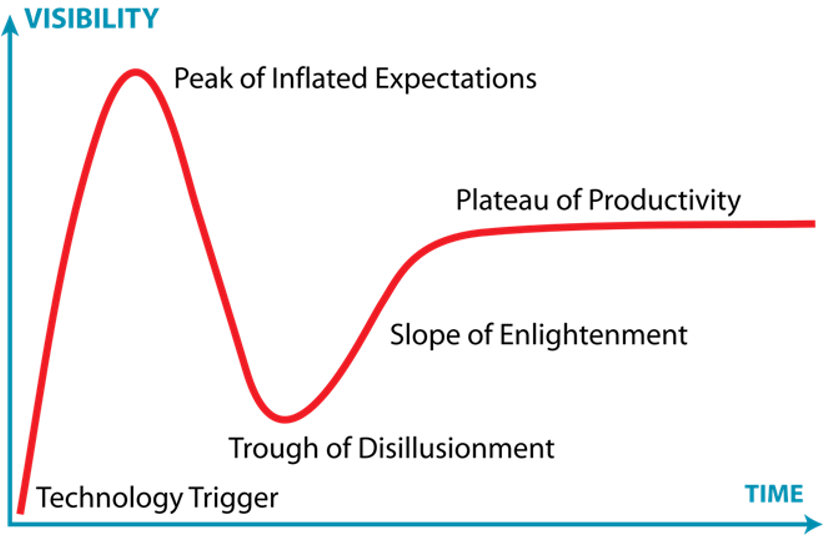
Gartner, from many moons ago.
An Ode to Ordinary
A few years ago, I wrote about how O&G Data is Different: O&G companies are (rationally) slow adopters of new digital technologies because their leadership is risk-averse. The E&P business is full of huge, difficult-to-mitigate risks that can wreck a company: volatile commodity prices, health & safety incidents, and changing regulatory landscapes. Those uncontrollables lead executives to hold tightly to what remains under their control—staffing, technology, legal agreements.
It’s understandable if E&P leaders look at the roller coaster on the Front Half of the Hype Cycle and say, “Thanks but no thanks.” While we can make the Front Half more manageable, the tiger can’t change its stripes.
Slope and Plateau technologies rarely make headlines or attract much buzz. These are the mature O&G workhorses—3D seismic, rotary steerables, ESPs, SCADA—steady, reliable, and quietly generating enormous value.
Let’s dig into three Back Half examples that stand out:
- Data warehouses & business intelligence tools (high-ROI Plateau)
- Blockchain for supply chain (low-ROI Plateau)
- ML for outlier detection, DCA, and well prediction (on the Slope)
Data Warehouses and BI Tools
Data warehouses and BI tools have been revolutionary in the E&P industry over the last twenty years. The Spotfire/Core Lab collaboration in the late 2000s launched the E&P industry’s move away from Excel and towards modern, easy-to-use reporting tools. Since then, nearly every E&P has adopted Spotfire, Power BI, or both. To feed those, most companies end up using a centralized Data Warehouse (or lake or swamp or whatever your preferred nomenclature).
These tools are powerful, affordable, and relatively easy to learn. The ability to bring multiple source systems together breaks down discipline boundaries and makes it possible to see things you could never get out of a single enterprise software application. They are all very reasonably priced compared to an ERP or SCADA system, but Power BI is insanely cheap at $14/user/month. Cloud data warehouses to feed those tools have changed the game in terms of what it takes to stand something up. You can stand up an Azure SQL DTU instance with meaningful capacity for under $50/month, basically free. Snowflake, Databricks, AWS, and more have similarly compelling options.
Data warehouses and BI tools aren’t a fit for every situation, but if you have a recurring analysis or report that needs to run reliably and be securely distributed, they are a game-changer. New features continue to rollout (hello, MCP servers), but this is reliable, high-ROI stuff.
Blockchain for Supply Chain
In contrast, not all mature technologies reach a high plateau! One example is blockchain for supply chain use cases. This idea was all over the news in the late 2010’s—now, mostly silence. The promise was that a shared, trusted ledger would speed up the entire Procure-to-Pay pipeline, reduce disputes, and get everyone out of paper. For some in 2018-2022, this was almost a religious belief.
Then reality crashed in—turns out the problem wasn’t a missing shared ledger, but the same old enemy: bad data quality. Supply chain really suffers from Garbage In, Garbage Out—if lousy data gets entered in the field ticket, auto-approval workflows are a TERRIBLE idea. The startups pushing this never broke through to meaningful market share. Maybe if Enverus Open Invoice had really pushed the tech, it could have gone somewhere, but that didn’t come to pass.

So much hype in such a small graveyard.
That’s not to say blockchain doesn’t have any value propositions for O&G. Using stranded gas to power Bitcoin mines has made money for some operators, but that’s a completely different business model from a trusted ledger for the supply chain.
Machine Learning for Tough Problems
Our final example is the general use of machine learning to address particularly gnarly prediction problems. A large class of problems—classifying bad/weird data and forecasting future outcomes—has been addressed using mature ML models. There have been decades of research in this area. I recently read an excellent compendium assembled by Srikantha Mishra, Machine Learning Applications in Subsurface Energy Resource Management. Super nerdy, but there are a bunch of techniques out there that are extremely useful – names you might recognize like Random Forest, Support Vector Machine, and Neural Networks.
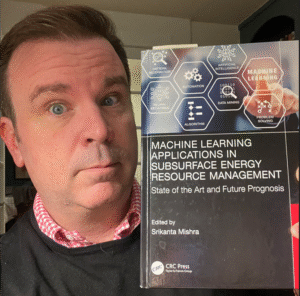
Machine Learning books give you crazy eyes!
Where do they shine? They find wide utility in tasks such as event classification in time-series data. Imagine all the data being collected by SCADA systems on producing wells. Once you’ve shown a supervised learning algorithm a few examples of something like a hole in tubing on a gas-lifted well, or fluid pound on a rod pumped well, it becomes trivial to identify when those conditions have occurred as they happen. You can use that information to change artificial lift settings and improve efficiency.
Another example I’ve been involved with for the last couple of years is automated/assisted decline curve analysis (DCA) in producing wells. Algorithms such as Markov Chain Monte Carlo (MCMC) have been shown to be useful for producing high-quality forecasts in certain situations. As that technology continues to mature, it’s highly possible they’ll eventually outperform humans at forecasting volumes for producing wells. Take a look at what the Society of Petroleum Evaluation Engineers has been doing in this area. It’s cool stuff if you haven’t seen it.
Note that I haven’t mentioned the term “AI” in this section at all. These techniques are usually “supervised machine learning” methods, a subcategory of AI. Over the last couple of years, AI has started to exclusively mean “generative AI.” Techniques like large language models (ChatGPT, LLaMa, Gemini) and diffusion models (MidJourney, NanoBanana, DALL-E) solve specific categories of problems but struggle with others. Traditional ML isn’t showing up on the WSJ’s front page anymore – instead, it’s increasingly acting like a Back Half of the Hype Cycle technology. These are weell-understood, robust techniques that bat at a high average.
AI’s gotten a lot of hype in the Oil & Gas Industry. Clients have told us that a product offering involving AI would sell, but would the results of that project make those clients excited to sign a follow-on scope of work? It remains to be seen if generative AI becomes a reliably high- or low-ROI technology.

Not as fast as Ichiro, sadly.
Wrap-up
These tools and techniques are worth your attention! In the Back Half, deploy them whenever the ROI is right. Why would you still use roller-cone bits if PDC bits will do the job faster and more efficiently? Why would you shoot 2D seismic when 3D seismic is so well-proven? Learning the lessons of Digital Technology Roller Coasters will pay off, even if it seems a bit boring.
The oil and gas industry already faces significant risks. Deploy high-ROI, low-risk technologies first, before venturing onto Front Half of the roller coaster!