


“How many wells do we own?”
This question can derail dashboard development, delay an acquisition analysis, and turn a 15-minute meeting into a cross-discipline argument that eats the rest of your day.
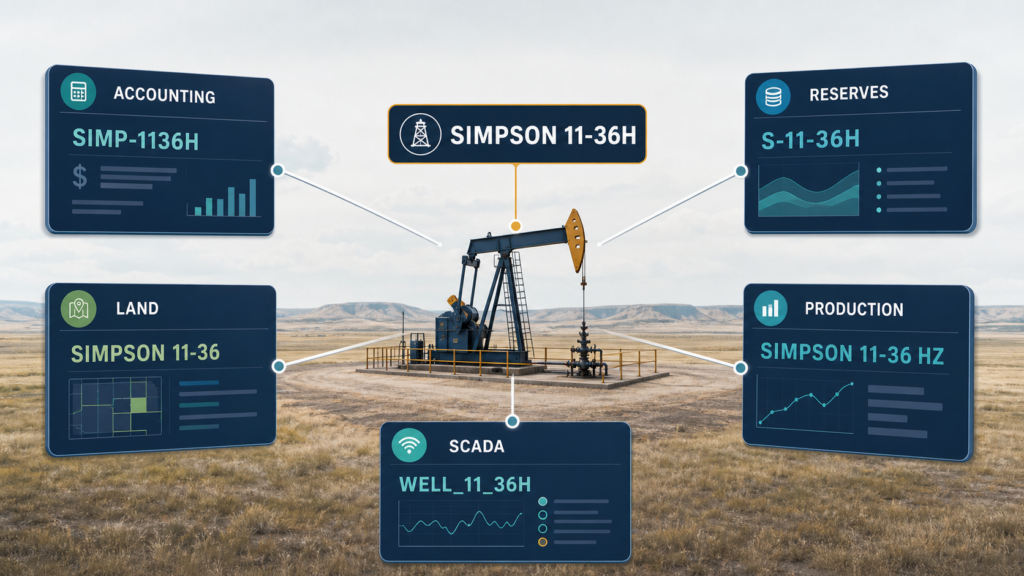
What is a well? Boots on the ground, it’s an easy question. “It’s this one right here. The Simpson 11-36H. I’m looking right at it. What do you mean Accounting doesn’t show that well? They have a Simpson Federal 11-36? Obviously that’s the same well! The ID’s don’t match? What ID are you talking about? I’m looking right at the well!”

In my head it’s this well.
The most important workflows in Oil & Gas require multidisciplinary data to execute:
- Production vs. Forecast requires Production and Reserves
- CAPEX review requires Accounting, AFE Budget, & Field Estimate data
- Interest factor review requires Land, Reserves, and Accounting
None of those are possible unless those departments agree which wells are which. Accounting, Reserves, Production, and Land all have their own unique identifiers (UID), but don’t get me started on using an API number as your cross-system reference. How can you be confident everyone’s talking about the same well?
The Wellmaster List
A wellmaster is a map of UID’s across systems. A physical asset like a well should have an AccountingID, Property Number, WellID, API10, API14, Lease Name, Well Name, and SCADA tags that all tie to the same well. Systems disagree in part because wells get created at different times in different systems by different people. It requires human intervention, organization, and effort to force those systems to agree on what well they’re all talking about. But why go to the trouble?
Benefits of Wellmastering
If you’re still slinging spreadsheets at coworkers you can probably delay your wellmastering initiative. Well list QC between departments can be done manually without causing major distractions.
Once you get sick of exporting and transforming data in Excel, automated reporting tools like Spotfire or Power BI can connect to back-end data. But only if they can reliably determine which wells in one system match wells in another. When the Wellmaster breaks down, the automation breaks down with it.
In the age of AI, this becomes even more important. AI can search, summarize, and analyze information faster than any analyst, but it still needs a consistent way to identify the assets behind that information. If one well looks like three different wells (or three wells look like one) AI will produce answers faster, not necessarily better. You have to master the data before you can trust the intelligence built on top of it.

Feed AI bad data to generate even more bad data even faster!
Good Wellmastering Enables
- Reliable BI dashboards
- Accurate & timely reserves reconciliation
- Faster CAPEX reviews with minimal prep
- Accounting reconciliation
- Regulatory compliance and emissions reporting
- Accurate AI initiatives
Without it, everyone spends time arguing whose numbers are right.
Poor Boy Wellmaster
In the past we’ve recommended MDM Lite as a reasonable path for operators to gain most of the benefits of a comprehensive wellmastering project in a simpler form factor. In short, Reserves tends to gain new wells first when they get put on a development schedule. By storing UID’s from related systems in the Reserves system you can use the Reserves header table as a master well list. This still requires effort, communication, and structure, but we’ve found for many of our clients this works well.
Full Bore Wellmaster
I regret to inform you that this is AI.
Generally this comes after a Data Warehouse in your digital maturity journey, but companies of a certain size require a full inventory of all UID’s from every system in a single reusable repository. Setting up rules and business logic in a data warehouse lets you create a grid of all potential well/lease/cost centers and how they map from system to system. You’ll set up rules on how to deal with when a single UID from one system matches multiple entities in another (waterfloods, most commonly) and identify where UID’s are missing or wells need to be created. You’ll have to schedule meetings with key stakeholders, volun-tell people that this is important to the Company, and reward peoples’ efforts in creating and maintaining these systems.
A Project Manager is almost certainly a requirement here, as everyone else involved has a day job and a boss with different priorities.
Common Mistakes
Most failed wellmastering efforts don’t fail because the matching logic is impossible. They fail because the company treats the project as a one-time data cleanup instead of an ongoing business process. Common mistakes include:
- Assuming API number is a complete and reliable cross-system key
- Trying to solve every asset type and every historical exception at once
- Letting one department build the master without input from the others
- Failing to assign an owner for exceptions and future maintenance
- Building a mapping table without documenting why the matches were made
- Underestimating the amount of communication and project management required
A technically perfect mapping that nobody owns will begin going stale almost immediately.
Where to Start
You do not need to master every well, lease, facility, and meter on day one. Start with one business problem that already matters: capital reporting, interest-factor QC, production reconciliation, or an acquisition integration.
Identify the systems involved, make a live, refreshable connection to their well lists, and determine:
- Which identifiers are unique within each system
- Which attributes can help confirm a match
- Where one record maps to several records in another system
Keep the original identifiers. Record the source of every match. Create an exception queue instead of forcing questionable matches. Most importantly, decide who owns the wellmaster after the project team moves on.
Can’t Someone Else Do It?

(Whines) Can’t someone else do it?
Maybe you’ve already tried to get folks to engage with a wellmastering project, but day to day responsibilities got in the way. You’re not alone. Everyone involved has a day job, and wellmastering usually crosses departmental boundaries without fitting neatly inside anyone’s job description. If you have a manageable number of systems, committed stakeholders, and someone empowered to own the result, you may be able to handle the project internally using the steps above.
If you’ve tried before and the project stalled—or if your company has acquisitions, complex ownership structures, waterfloods, multiple accounting systems, or years of accumulated exceptions—an experienced outside partner can save substantial time and rework.